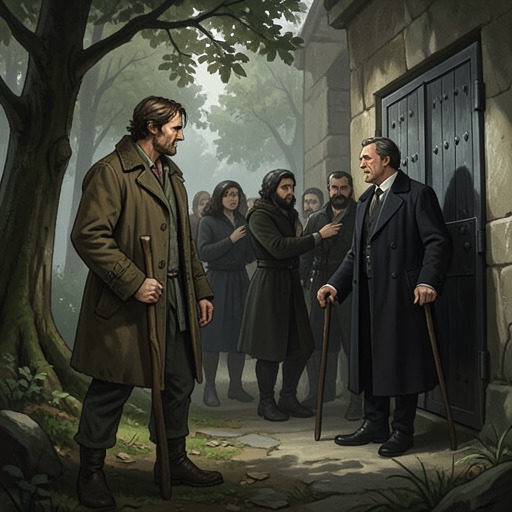
Lipce villagers’ collective settlement talks with the squire collapse
The PeasantsLipce villagers’ collective settlement talks with the squire collapse because shared grievances do not translate into a shared negotiating position. The squire’s offer briefly makes agreement seem possible, but hesitation, competing demands, and mistrust divide the villagers; his response is to withdraw from the talks and prohibit their cattle from using the woodland pastures. The episode exposes the fragile boundary between collective resistance and collective bargaining: Lipce can assemble against an immediate injustice, yet struggles to hold together when compromise requires individuals to accept common terms.
Causes and Stakes
The negotiations grow out of an ongoing struggle over land, forest use, and access to work. For Lipce’s poorer households, the squire’s decisions are not abstract questions of ownership. During a hard winter, hired laborers have little income, some have already lost potatoes to frost, and families face a lean preharvest season. A hot meal only once a day and empty stomachs at bedtime are part of the reported hardship. Many had counted on the squire’s planned felling at Wolf’s Hollow to provide employment; instead, he refuses to hire any Lipce men, angered by a complaint lodged against him with the commissioner.
The forest dispute also has a history of contested customary access. Villagers complain that their registered pasturage is repeatedly challenged, and one account blames the expulsion of cattle for a cow’s death after the animal was worn out by the chase. The reported loss is valued at three hundred zlotys. For Boryna, the woods embody both a material claim and a lasting attachment: he counts four morgens as his and adds Jagna’s one morgen to his reckoning, while insisting that the villagers will not accept the manor’s attempt to diminish their rights. These grievances help explain why a settlement over land and grazing carries consequences well beyond the terms of a single agreement.
From Resistance to Negotiation
Earlier, the villagers had answered the threatened felling with open mobilization. At a crowded gathering outside the inn, they waited for Boryna, whom they regarded as the village’s leading farmer. He called farmers and hired hands together, presented the manor’s logging, refusal to employ them, and repeated injuries as parts of the same injustice, and urged them to defend what they regarded as theirs. The crowd went home to prepare, then assembled with poles, pitchforks, flails, and other implements before setting out for the forest. There Boryna confronted the woodcutters and demanded that they leave, declaring the forest theirs.
The later settlement talks require a different kind of solidarity. Collective force can make the villagers’ opposition visible, but an agreement asks them to settle on specific terms and accept a common outcome. When the talks reach the point of signing, some men hesitate, one wants to consult his wife, and another seeks the addition of a neighboring meadow. The blacksmith reports that the squire, frustrated by their inability to decide, wants nothing more to do with an agreement. What had seemed to be a common purpose breaks into individual reservations and claims.
Collapse and Immediate Consequences
The squire responds to the failure by ordering that no Lipce cattle may graze on the woodland pastures; any animals turned loose there are to be confiscated. The order makes the cost of the failed talks concrete. Rather than resolving the dispute over access, negotiation ends with a direct new restriction on village households and a threat to their livestock. News of the decision dismays those gathered, who curse the people they hold responsible and begin arguing more fiercely among themselves.
Mateusz identifies confusion and the absence of anyone able to bring the villagers to reason as part of the problem. His complaint points to the weakness exposed by the episode: the community can recognize shared injury, but agreement is harder when each household weighs its own needs and the squire controls the terms of access. The blacksmith’s account also reveals that the squire had been willing, at least initially, to discuss an agreement; his withdrawal follows the villagers’ failure to sign, and the grazing ban follows that withdrawal.
Significance
The collapse links economic hardship to the limits of village politics. The land and forest disputes affect grazing, employment, and the possibility of keeping households supplied through winter and the preharvest months. In the village, however, poverty does not automatically produce mutual aid. A woman describing hunger and sickness among poor families observes that better-off farmers attend to their own food and lending rather than the suffering of neighbors, leaving the poor to divine providence. That wider division echoes the settlement’s failure: common dependence on land does not erase differences in resources, demands, or willingness to accept risk.
The episode also contrasts two forms of collective action. At the forest, a crowd gathers behind Boryna and moves together against the woodcutters; at the negotiating table, common opposition proves insufficient to secure a common decision. The squire’s grazing order demonstrates the consequences of that fracture, while the villagers’ anger shows that the underlying dispute remains unresolved. Their capacity to act together is real, but contingent—and the gap between resisting an imposed decision and agreeing among themselves becomes one of the community’s central political weaknesses.